
Search Horry County Court Records
Horry County court records are not held in one complete public database. The Horry County Trial Court Public Index is the central online route for many Circuit Court and Magistrate Court records. The state case search landing page lists Horry County under Judicial Circuit 15 and county number 26. The public index requires cookies and JavaScript, and some browsers may need a pop-up exception for case detail. It can show case number links, party names, action tabs, financials, Switch View, and document icons where images are available.
Other official systems fill the gaps. The South Carolina Family Court Public Portal is separate from the public index. Traffic tickets may use the state traffic ticket search or the issuing municipal court. Probate and marriage records are handled by Horry County Probate Court. Federal records use PACER or the federal court involved. For older files, certified copies, or non-online records, use the Horry County Clerk of Court, Probate Court, municipal court, sheriff records process, or Horry County Public Information FOIA channel.
- Identify the record type first: Circuit civil, General Sessions criminal, family, probate, traffic, municipal, jail, sheriff, or federal.
- Use the public index for many Circuit and Magistrate case records, then accept the disclaimer and validate the security code.
- Search by case number when available, or use name, court type, agency, case type, date, tax map, judgment, or action filters.
- Open the case number link and review enabled tabs, financials, document icons, and Switch View.
- Use the relevant court office or records request path when a case is not online or a certified copy is needed.
The home-page public index image was captured from the Horry County Trial Court Public Index.
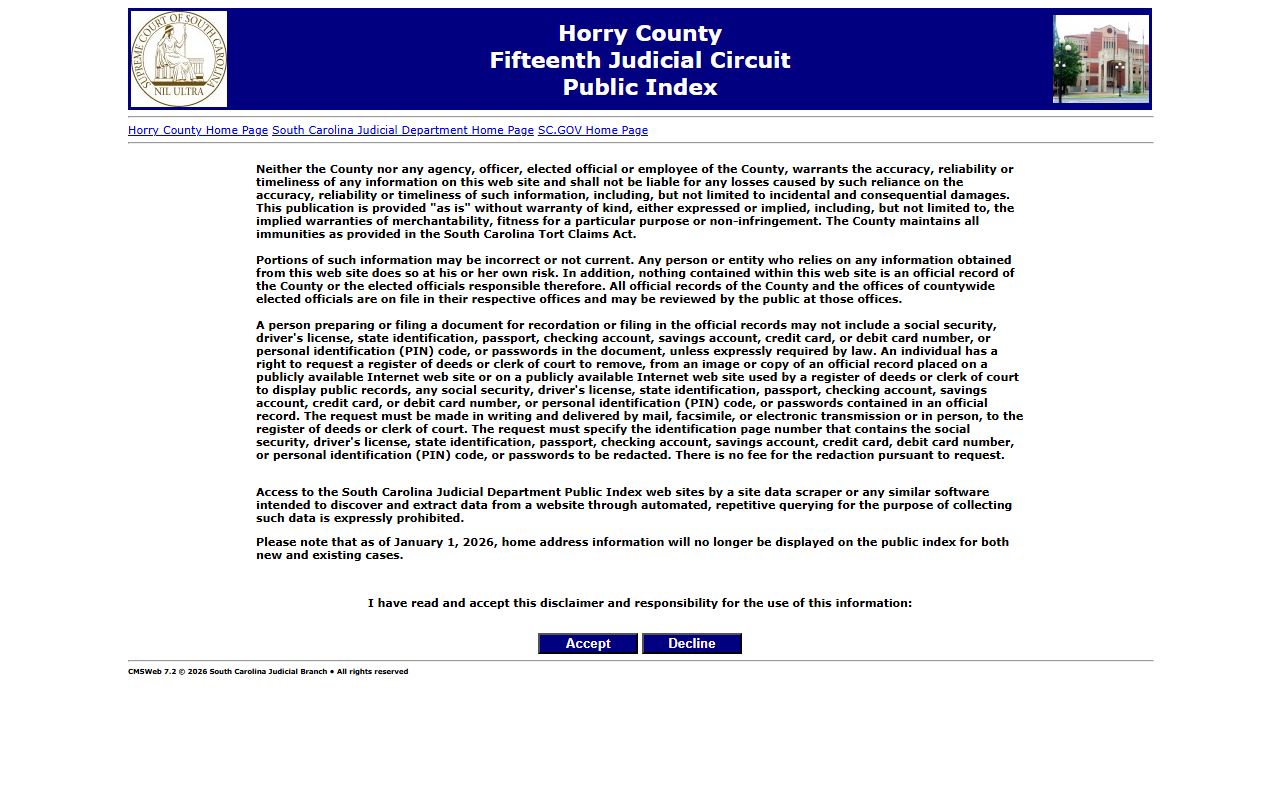
That screen is a main entry point for Horry County Court records, but family, probate, traffic, jail, and federal records still require separate channels.
Where Horry County Records Start
The most reliable first step is matching the request to the record custodian. Horry County has a unified Clerk of Court for Circuit and Family Court, a county Probate Court, a set of magistrate courts, several municipal courts, and sheriff and detention systems. The Register of Deeds Acclaim search is official, but it is for recorded documents and land records, not a criminal case search. A federal case, federal bankruptcy, or federal appeal will not appear in the Horry County public index.
| User Goal | First Official Channel | Backup Channel |
|---|---|---|
| Circuit civil case | Horry Public Index | Clerk Common Pleas, 843-915-5083 |
| General Sessions criminal case | Horry Public Index | Clerk General Sessions, 843-915-5084 |
| Divorce or family case | Family Court Public Portal | Clerk Family Court, 843-915-5081 |
| Probate or marriage record | Horry Probate Court | Probate phone, 843-915-5370 |
| Traffic ticket | SCCourts Traffic Ticket Search | Central Traffic Court or issuing city court |
| Jail booking | Horry bookings app | J. Reuben Long Detention Center or Sheriff's app |
| Warrant risk | Issuing court or Sheriff's Office | Public Index, booking app, or HCSO app most wanted |
| Federal case | PACER or federal court | U.S. District, Bankruptcy Court, or Fourth Circuit |
Note: Do not treat a missing online result as proof that no court date, ticket, warrant, or restricted file exists.
Horry County Court System
Horry County is in South Carolina's Fifteenth Judicial Circuit with Georgetown County. The primary county-level trial court is Circuit Court. Its Common Pleas division handles civil matters, while General Sessions handles criminal prosecutions. Family Court is statewide and handles divorce, custody, support, adoption, name changes, termination of parental rights, and juvenile matters. Probate Court handles estates, wills, guardianships, conservatorships, trusts, marriage licenses, minor settlements, and involuntary commitments.
Lower courts matter for many searches. Magistrate Court handles small civil claims up to $7,500, lower-level criminal offenses, bail, preliminary hearings, and arrest or search warrants. Municipal Courts handle city ordinance and qualifying traffic or criminal matters within municipalities such as Myrtle Beach, North Myrtle Beach, Conway, Surfside Beach, Atlantic Beach, Aynor, Loris, and Briarcliffe Acres. Appeals and higher review can move from trial courts to the Court of Appeals or Supreme Court, while federal matters use federal courts.
Common case flow: Municipal or Magistrate Court › Circuit Court › Court of Appeals › Supreme Court, when a case type allows appeal.
| Court | Function | Common Horry County Records |
|---|---|---|
| Circuit Court | General jurisdiction trial court. | Common Pleas civil cases and General Sessions criminal cases. |
| Family Court | Domestic and juvenile jurisdiction. | Divorce, custody, support, adoption, name change, and juvenile matters. |
| Probate Court | Estate and protective proceedings. | Estates, wills, guardianships, conservatorships, trusts, and marriage licenses. |
| Magistrate Court | Lower civil, criminal, bond, and warrant work. | Small claims, landlord-tenant, bail, preliminary hearings, warrants, and many traffic matters. |
| Municipal Court | City ordinance, traffic, and qualifying criminal cases. | City tickets, local offenses, bench warrants, and municipal hearings. |
Horry County Courthouse Offices
The main court campus is the Horry County Courthouse and Government & Justice Center at 1301 Second Avenue in Conway. The South Carolina Judicial Branch and Horry County use this address for the Clerk of Court, Probate Court, Solicitor, and related court-facing services. The Clerk of Court is Renee N. Elvis. Probate Judge R. Allen Beverly, Jr. handles the Probate Court, and the Fifteenth Circuit Solicitor is Jimmy Richardson.
Horry County Courthouse
1301 Second Avenue
Conway, SC 29526
Clerk: 843-915-5080
Horry County Probate Court
1301 Second Avenue, second floor
Conway, SC 29526
843-915-5370
Horry County Court Record Types
Horry County court records include more than standard civil and criminal case files. Common Pleas records can include complaints, answers, motions, orders, judgments, lis pendens, foreclosure actions, tax-map references, and financial tabs. General Sessions records include charges, indictments, pleas, hearings, motions, dispositions, sentencing, court costs, and financial entries. Magistrate civil records include small claims and landlord-tenant files. Municipal records include city tickets, ordinance matters, and local criminal proceedings.
Family Court records include divorce, custody, support, alimony, adoption, name change, and juvenile proceedings, but adoption and juvenile files are restricted. Probate files include wills, appointments, inventories, creditor notices, accountings, closing statements, small estate materials, guardianships, conservatorships, trusts, and marriage license records. Traffic records may sit in Central Traffic Court, a Magistrate Court, or a city court. Jail booking records show custody and charge information, but the court case file must be checked for final court action.
- Civil records show lawsuits, judgments, foreclosure-related matters, and Magistrate civil claims.
- Criminal records show charges, indictments, pleas, hearings, dispositions, sentences, and costs.
- Family records show divorce and support matters where public access is allowed.
- Probate records show estate, will, guardianship, conservatorship, trust, and marriage-license matters.
- Traffic records show citation, court date, disposition, fine, and payment information.
What Horry County Court Records Show
Public index results commonly show a case number, court type, court agency, case type, subtype, party names, roles, action types, action dates, filed or disposed date filters, financial data, and available document icons. The system may also show tax-map numbers for property-related cases, judgment filters, multiple-party controls, and Switch View. These fields help identify the correct case, but they do not guarantee that every pleading, order, image, or restricted filing is online.
| Field | What It Means |
|---|---|
| Case Number | The court file number and result link. |
| Party Names | Plaintiff, defendant, petitioner, respondent, or other roles. |
| Action Type | A motion, order, hearing, judgment, ADR event, or other case activity. |
| Financials | Fines, fees, payments, and court costs when displayed. |
| Disposition | The case or charge outcome, which is not always the same as dismissal. |
| Document Icon | An available image link, if the system provides one for that case. |
The Family Court portal screenshot was captured from the South Carolina Family Court Public Portal.
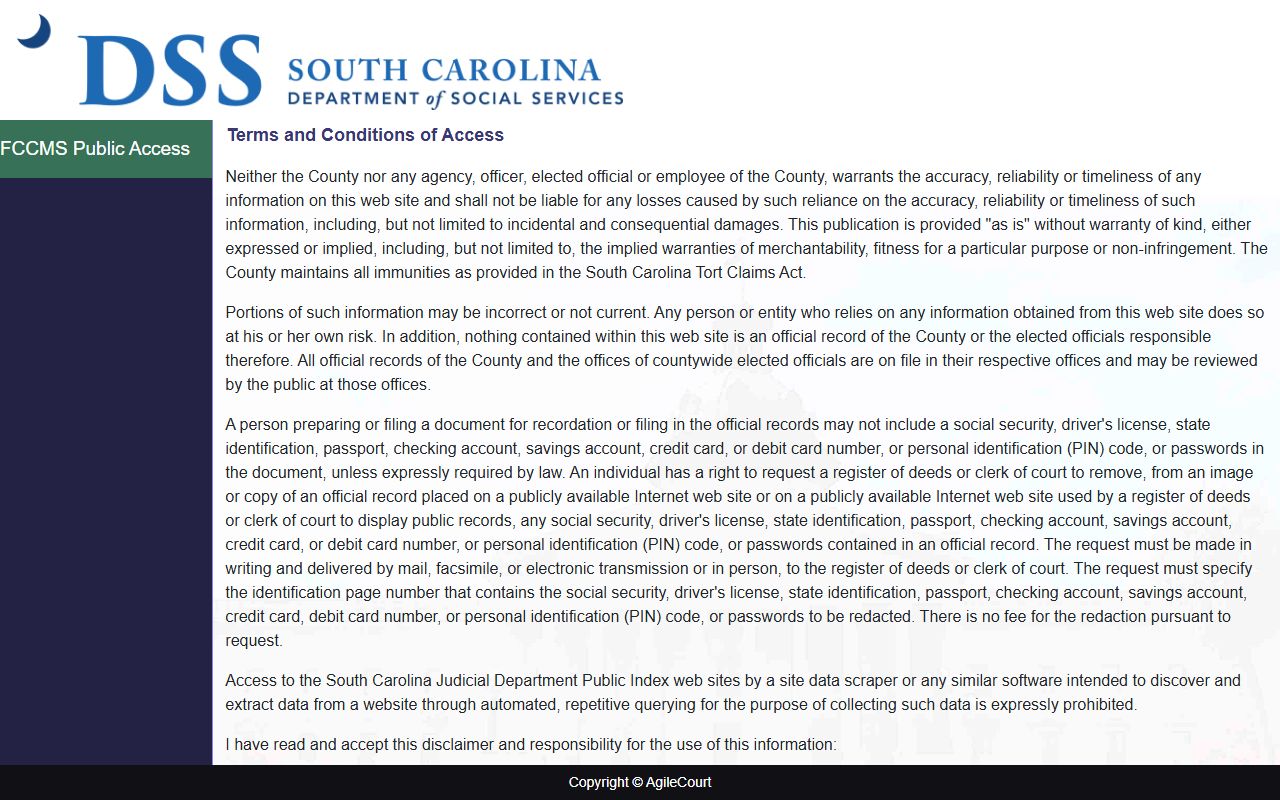
Family Court access is separate because divorce, custody, support, adoption, and juvenile files have their own public-access rules.
Horry County Court Records Access Laws
South Carolina's public records framework begins with the Freedom of Information Act, including public access to nonexempt records and fee limits tied to actual cost. Court records also depend on court rules and specific confidentiality statutes. S.C. Code 30-2-330 controls personal identifiers in online public records. The Judicial Branch states that home address information will no longer display on the public index for new and existing cases beginning January 1, 2026. Juvenile records are confidential under S.C. Code 63-19-2010 unless a court order or statute allows access.
Key South Carolina access rules:
S.C. Code 30-4-30 allows inspection and copying of nonexempt public records, with actual-cost fee limits.
S.C. Code 30-4-40 lists exemptions for privacy, law-enforcement harm, safety, sources, and similar limits.
S.C. Code 30-2-330 supports redaction of restricted identifiers in internet-accessible public records.
S.C. Code 63-19-2010 makes juvenile court records confidential except as authorized.
Restricted Horry County Court Records
Restricted records include juvenile files, adoption files, sealed records, expunged criminal information, mental-health and involuntary commitment records, and filings that contain personal identifiers. Law-enforcement records can also be withheld when disclosure would interfere with a proceeding, reveal a confidential source, expose techniques, invade privacy, endanger safety, or create fair-trial issues. The correct response is not to assume the record does not exist. Instead, contact the court or agency that holds it and ask what access path applies.
Expungement in South Carolina is routed through the solicitor's office for the judicial circuit where the charge originated. In Horry County, the Fifteenth Judicial Circuit Solicitor provides the criminal process and expungement path. After expungement, public systems may redact, omit, or limit public charge details. A public booking sample even showed an old charge number marked EXPUNGED, which reflects how public display can change after a court or solicitor process.
Horry County Specialty Court Programs
Horry County research identified several specialized criminal and treatment-related paths. Probate Judge R. Allen Beverly, Jr. is listed by the county as Drug Court Judge for the Fifteenth Circuit Solicitor's Office. Sheriff Phillip E. Thompson's county biography describes an in-house drug treatment program at J. Reuben Long Detention Center, presented as a therapeutic community aimed at addiction, criminogenic thinking, recidivism reduction, and reentry. The same county materials describe a partnership with SCDC Youthful Offenders Intensive Supervision Services.
The Solicitor's office also lists Horry County Mental Health Court in treatment-court navigation, though the research file did not capture a full eligibility page. The Juvenile Arbitration Program is a separate community-based process for first-time juvenile offenders charged with nonviolent crimes. It requires admission of guilt and completion of conditions within 90 days, such as restitution, community service, education, counseling, essays, or apologies. Successful completion can result in dismissal, while failure returns the matter to Family Court prosecution.
The Solicitor biography image was captured from the Fifteenth Circuit Solicitor biography page.
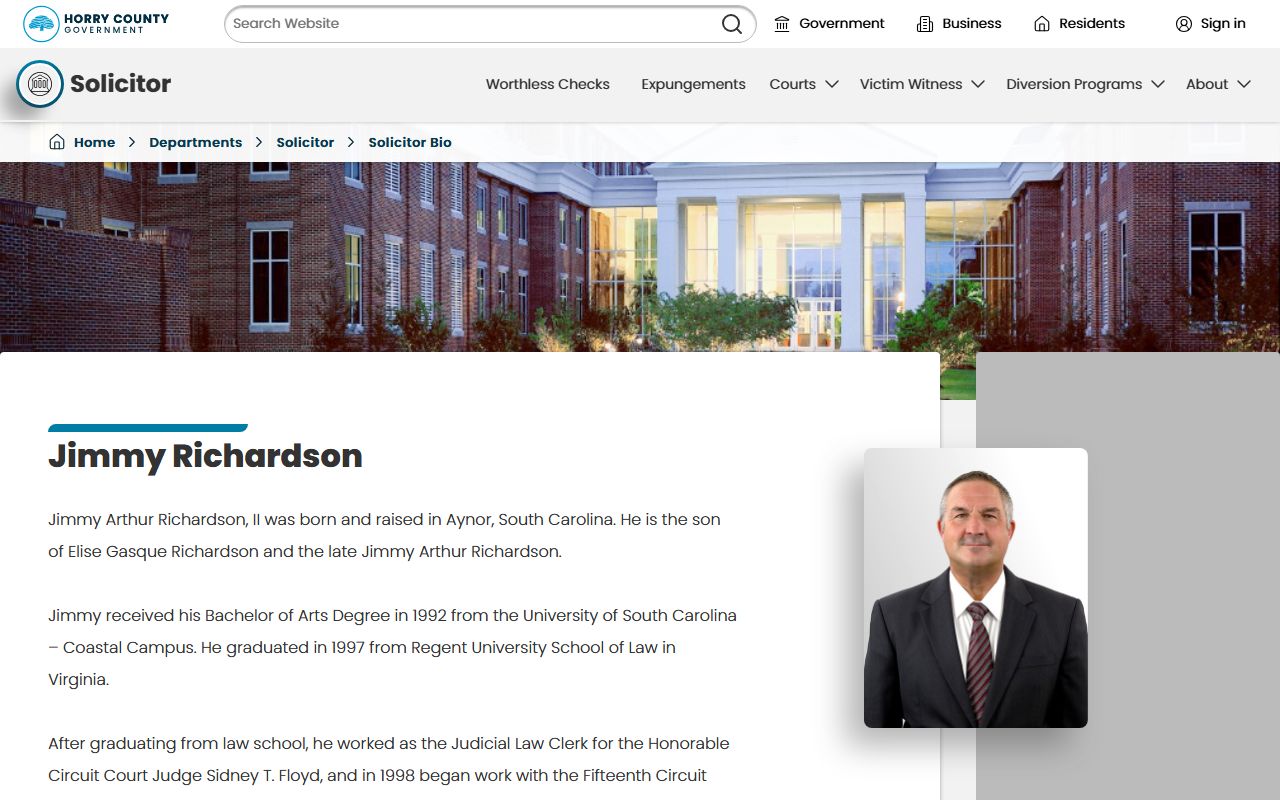
The Solicitor's office is part of the Horry County criminal court process because it prosecutes General Sessions and certain Magistrate Court matters.
Horry County Sheriff and Jail Records
The Horry County Sheriff's Office is led by Sheriff Phillip E. Thompson. County materials describe the office as responsible for assisting other law-enforcement agencies, protecting the courts and community, providing courthouse security, operating J. Reuben Long Detention Center, serving civil process, filing and serving criminal warrants, tracking registered sex offenders, and operating support functions. The jail and sheriff systems are important for booking and warrant-linked records, but they are not the same as final court records.
The official Horry bookings app searches people booked at J. Reuben Long Detention Center or by the City of North Myrtle Beach. It uses last name, booking date, and release date fields. Results can show mugshot, booking number, booking date, release date, gender, age, ethnicity, arresting agency, home detention, charges, bail amount, disposition, and counts. SCDC is separate and covers sentenced state-prison inmates after transfer or sentence, while federal custody uses the Bureau of Prisons locator.
The Horry bookings image was captured from the official Horry County bookings and releases app.
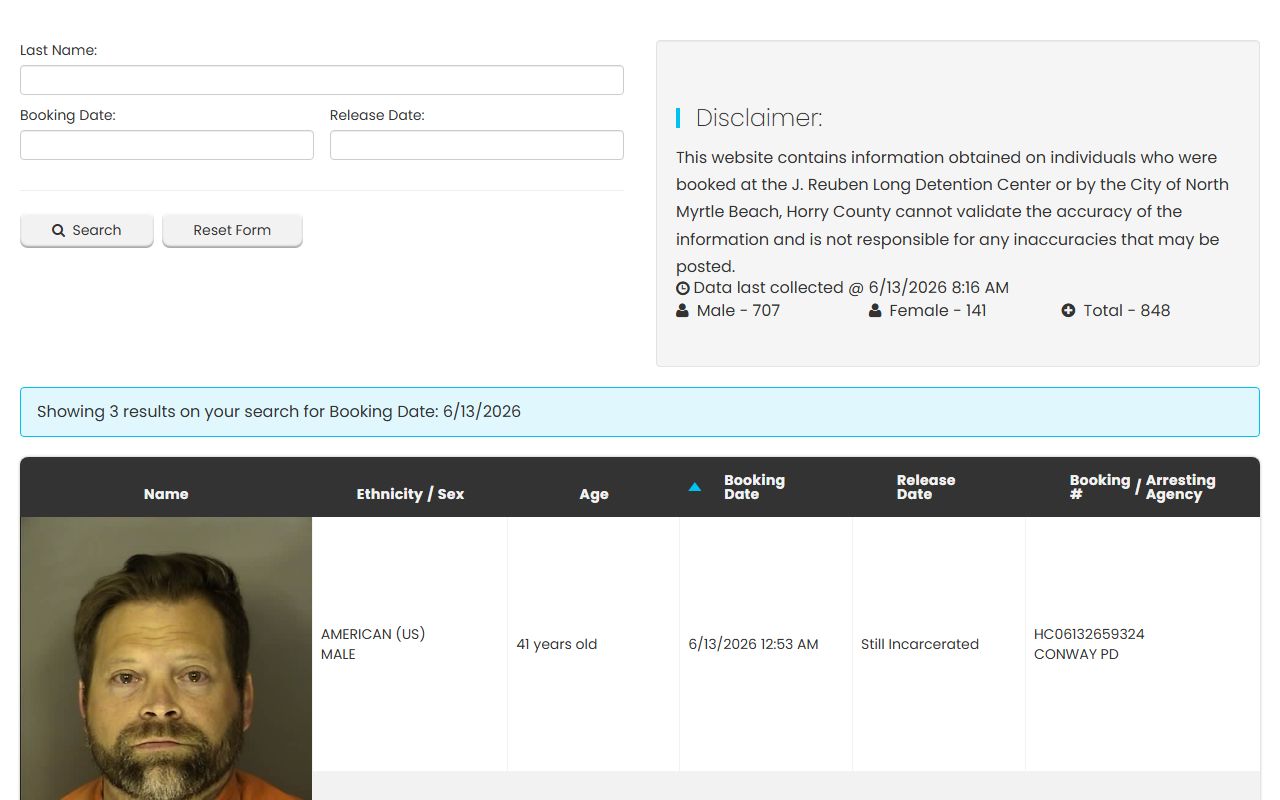
Booking data can help locate custody and charge information, but final court disposition should be verified through the court record.
Horry County Traffic Court Records
Traffic records in Horry County may be in Central Traffic Court, a Magistrate Court, or a municipal court, depending on the issuing agency and location. The SCCourts Traffic Ticket Search allows searches by citation or ticket number, driver's license number, first name, last name, and county or court filters where required. SC.gov instructs users to choose Horry County, accept terms, complete the Captcha, enter a ticket number, name, or license number, search, and pay with a credit card where eligible.
A court traffic record is different from an SCDMV driver record. The court record shows citation, charge, court date, disposition, fine, and payment status. The driver record is a licensing history that may show convictions, points, suspensions, and license status. Myrtle Beach Municipal Court has detailed local rules, including court sessions at 9 a.m. and 2 p.m. Monday through Friday, payment by online, phone, or court window, continuance requests at least 24 hours before court, and appeals within 10 days to the Court of Common Pleas in Conway.
The traffic ticket image was captured from the South Carolina traffic ticket search page.
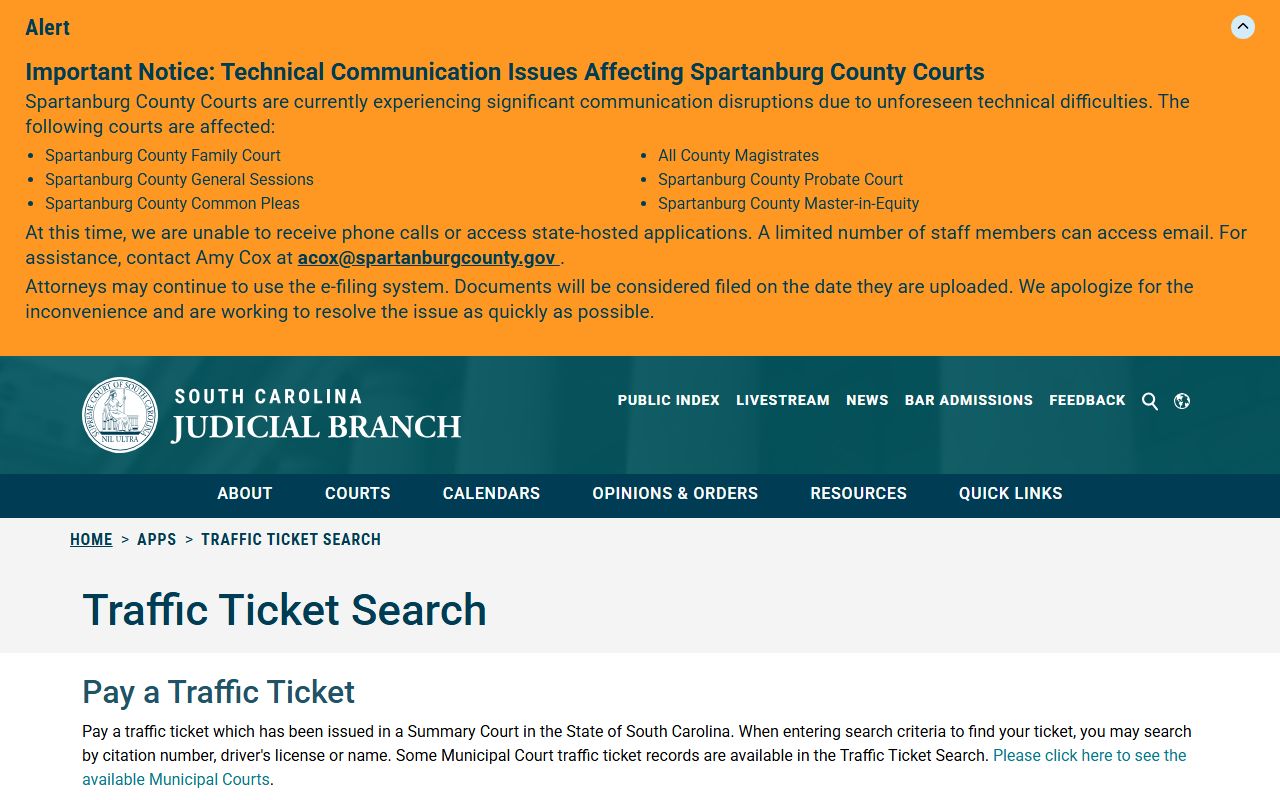
That search path helps with many court ticket records, while city tickets may still require the issuing municipal court.
Horry County Family and Probate Records
Marriage licenses and estate matters are Probate Court records in Horry County. The Probate Court is on the second floor of the Horry County Judicial Complex and handles marriage licenses, estates, wills, guardianships, conservatorships, trusts, involuntary commitments, minor settlements, wrongful death and survival settlements, and power-of-attorney matters. Marriage license fees differ by residency status, and certified marriage copies use separate fees for 1994-current records and older records.
Divorce is a Family Court matter, not a Probate Court record. The Horry County Clerk of Court provides Family Court contact and forms, including divorce packets. Some divorce documents may be public, but custody, support, minor, adoption, juvenile, sealed, and financial-identifier material can be restricted. Probate estate files do not replace death certificates, and bankruptcy does not replace probate. Bankruptcy is federal, while Probate Court handles deceased-person estates and protective proceedings.
Federal Records for Horry County
Federal court records are outside the Horry County court system. Horry County is in the U.S. District Court for the District of South Carolina, and federal records are searched through federal court systems. PACER is the official path for federal dockets and filings. The U.S. Bankruptcy Court for the District of South Carolina handles bankruptcy records. Federal appeals go to the Fourth Circuit. Federal criminal, civil-rights, federal-question, bankruptcy, tax, collection, and appeal records will not appear in the Horry County Trial Court Public Index.
Horry County Records Fees
Research did not locate an official Horry Clerk copy and certification fee table for ordinary court copies, so those amounts should be confirmed with the Clerk before ordering. Horry County Public Information does publish FOIA costs for administrative records. Probate marriage records and detention-related bond payments have their own fee rules. A certified court copy, a public index screen, an Acclaim document purchase, and an administrative FOIA copy are different products.
| Item | Amount | Office or Channel |
|---|---|---|
| County FOIA staff time | $25/hour | Horry County Public Information |
| County FOIA standard copy | $0.15 per 8.5 x 11 page | Horry County Public Information |
| 911 audio MP3 | $25/file, plus $5 if CD requested | Horry County Public Information |
| DVD/video | $15 | Horry County Public Information |
| Public Defender application | $40 | Paid to Clerk of Court |
| Marriage certified copy, 1994-current | $5 | Horry Probate Court |
Read Horry County Court Records
Several court terms appear across Horry County records. A docket is the chronological case activity list. A plaintiff files a civil case. A defendant is a sued party or accused person. A motion asks the judge for a ruling. An order is the judge's directive. A judgment is a final or enforceable court decision. A disposition is an outcome, not always a dismissal. General Sessions is the criminal division of Circuit Court, while Common Pleas is the civil division.
- Lis Pendens
- A notice that a lawsuit affects real property.
- Tax Map Number
- A property identifier used in real-estate-related civil matters.
- Bench Warrant
- A judge-issued warrant, often tied to failure to appear.
- Expungement
- A process that removes qualifying public criminal record information after legal review.
Horry County Record Limits
Online Horry County Court records can lag behind court action, omit document images, redact protected information, or route to a different court. Public Index records do not prove a full criminal history. Booking data does not prove final court disposition. A traffic ticket search does not show a full SCDMV driver record. A warrant-linked booking does not list every active warrant. Acclaim recorded documents are not the same as court case files. These distinctions matter when a record is used for legal, employment, housing, licensing, insurance, or safety decisions.
Note: Verify current case status, hearing dates, bond, payment, and certified-copy needs with the originating court office.
History of Horry County Courts
Horry County was established in 1801 and named for Revolutionary War figure Peter Horry. Conway is the county seat. The Old Horry County Courthouse on Main Street, now Conway City Hall, is listed in South Carolina Archives and History materials and reflects the county's long courthouse presence in downtown Conway. Current records, hearings, and court visits should use the modern county courthouse and justice center unless the question is specifically historical.
South Carolina's modern court system also changed over time. Family Court was created by statute in 1976, giving statewide family and juvenile jurisdiction. The South Carolina Court of Appeals began operation on September 1, 1983, changing the appellate path for many trial-court matters. Horry County court access today is a mix of courthouse offices, statewide court portals, county apps, municipal courts, and federal systems.
The Census QuickFacts screenshot was captured from U.S. Census QuickFacts for Horry County.
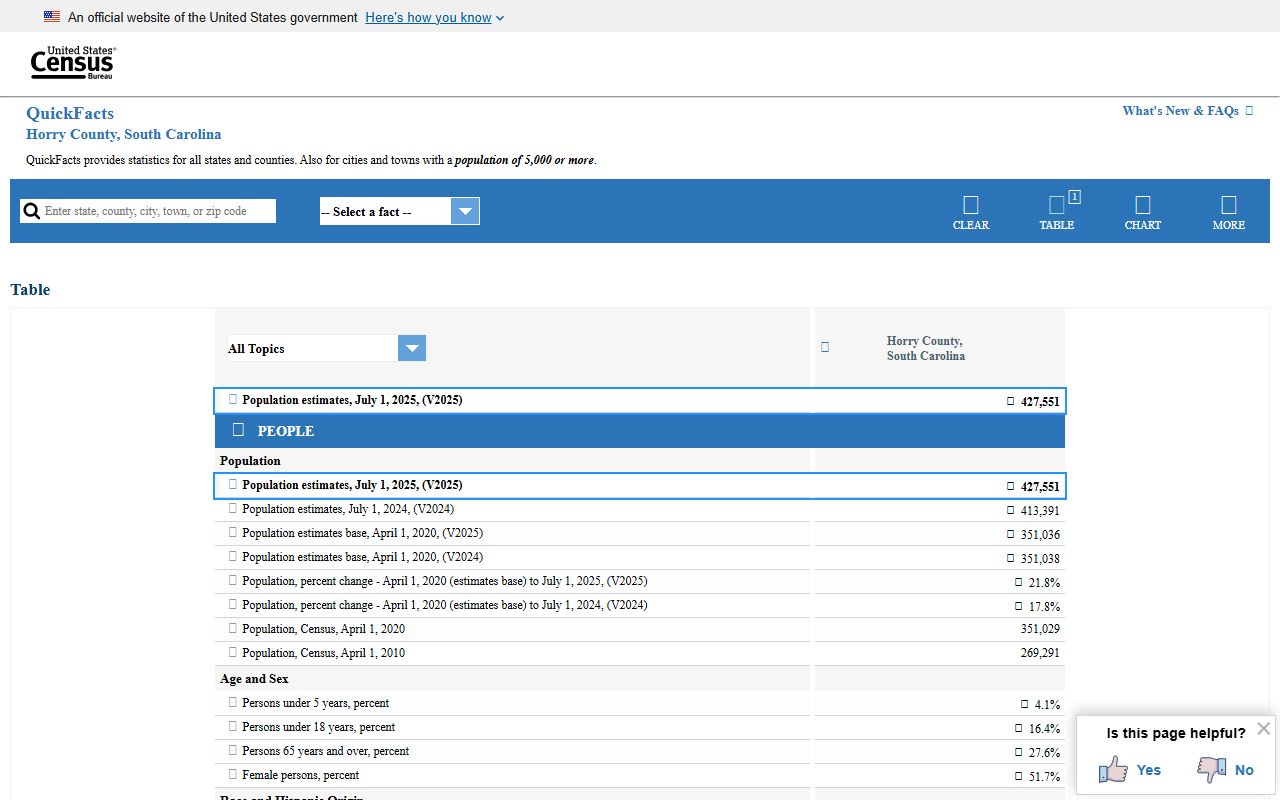
County size and coastal growth help explain why Horry uses multiple courts, offices, and online tools rather than one record window.
The sheriff biography image was captured from the Horry County Sheriff biography page.
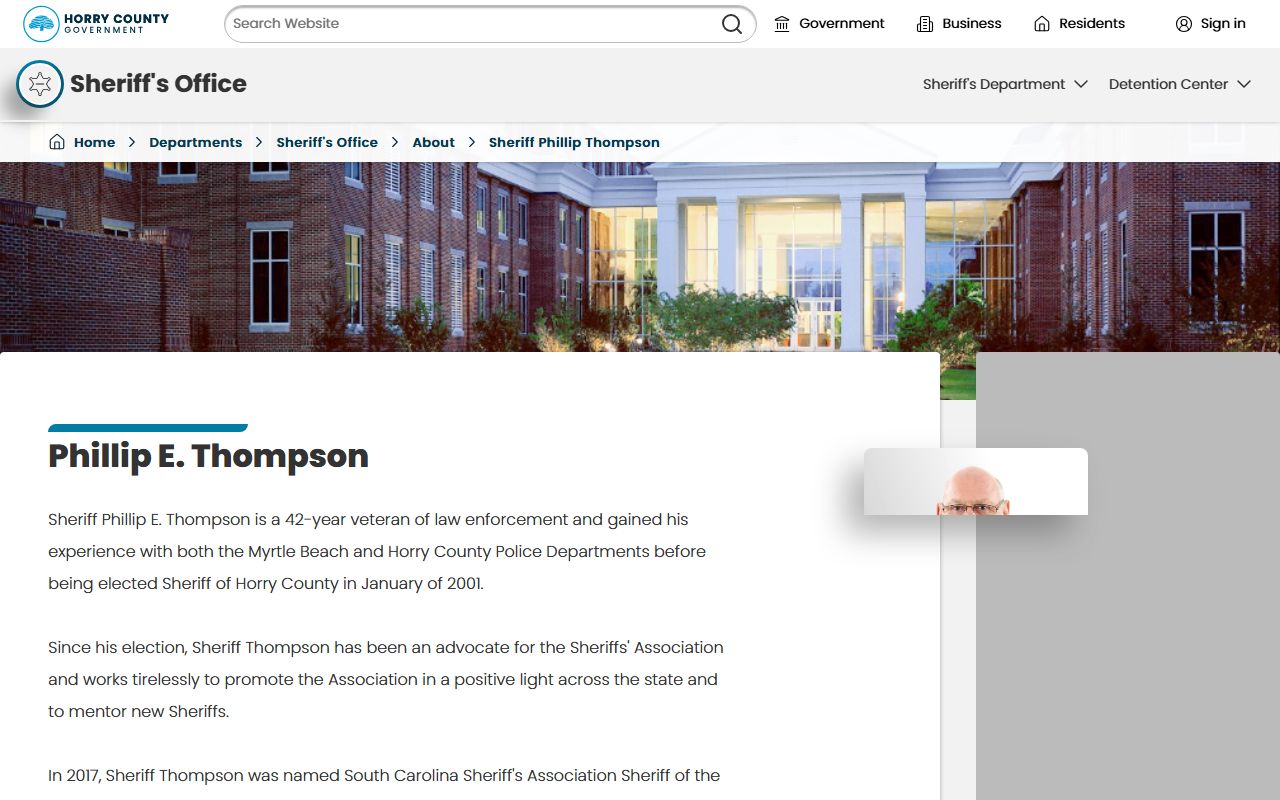
The Sheriff's Office is part of the broader court-record path because warrants, court security, detention, booking, and civil process intersect with court cases.
Horry County Court Records FAQ
Are all Horry County Court records online?
No. Many Circuit and Magistrate records can be searched through the public index, but Family Court, Probate Court, municipal courts, older files, sealed records, certified copies, and federal records may require another official channel.
Which court handles Horry County criminal cases?
Serious criminal prosecutions are handled in General Sessions, the criminal division of Circuit Court. Lower-level cases, warrants, bond matters, DUI jury-trial routes, domestic violence matters, and municipal cases may involve Magistrate or Municipal Court first.
Where are Horry County divorce records found?
Divorce is a Family Court matter. Use the Family Court Public Portal where available, the Clerk Family Court division, or the Clerk's forms and copy request channels. Probate Court handles marriage records, not divorce decrees.
Does Horry County have an official active warrant search?
The research sources did not locate a single official public active-warrant search for Horry County. Check the issuing court, Sheriff's Office, Public Index case events, booking app for people already booked, or HCSO app most wanted feature.
Is a public index result a certified court copy?
No. The public index is a search and case-detail tool. Certified copies must be requested from the proper court office, such as the Clerk of Court or Probate Court, depending on the file.
Public Record Search
Sponsored Results